Beauty
Therapists
Therapists
non-medics are now restricted from performing deep microneedling (≥1.5mm) unless you operate within a HIS-registered clinic and are supervised by a medic.
As of 17 March 2026, the Scottish Parliament passed the Non-surgical Procedures and Functions of Medical Reviewers (Scotland) Bill, making Scotland the first country in the UK to pass legislation regulating non-surgical cosmetic procedures, including Botox and dermal fillers. This legislation marks a move toward a high-accountability model, where almost all invasive cosmetic procedures are being transitioned under the oversight of Healthcare Improvement Scotland (HIS).
The core of the change is a "two-tier" risk system: lower-risk treatments will eventually fall under a local council licensing scheme, while higher-risk treatments, including microneedling at depths of 1.5mm or deeper, are now legally classified as medical procedures that must be performed in a HIS-registered clinic.
For non-medic practitioners like beauty therapists, the most significant change is the mandatory supervision rule that is being phased in toward a full enforcement deadline in September 2027. Under the new law, a non-medic can only perform "higher-risk" procedures if a qualified healthcare prescriber (such as a doctor or nurse) is physically on-site during the treatment. Furthermore, the Scottish Government has been granted enhanced powers to inspect premises, seize equipment, and issue fines of up to £20,000 for those operating outside of these permitted, registered environments.
non-medics are now restricted from performing deep microneedling (≥1.5mm) unless you operate within a HIS-registered clinic and are supervised by a medic.
any premises offering treatments that penetrate the skin at "medical" depths must now undergo the rigorous HIS registration process.
Mobile treatments considered high-risk procedures are effectively being phased out, as all such treatments must now occur in "permitted premises" (clinics, pharmacies, or dental practices).
The government is standardising qualifications; "fast-track" courses for non-medics are being heavily scrutinised, and practitioners will likely need to prove they hold Ofqual-regulated level 4 or 5 qualifications.
It is now a criminal offence to provide these cosmetic procedures to anyone under the age of 18 in Scotland.
Doctors, nurses, and dentists who "front" for non-medics without being physically present on-site during treatments may now face professional disciplinary action and legal liability.
While the new legislation broadly divides practitioners and businesses into two tiers (1. those requiring a local authority license; 2. those requiring HIS registration), treatments can be grouped into 3 categories:
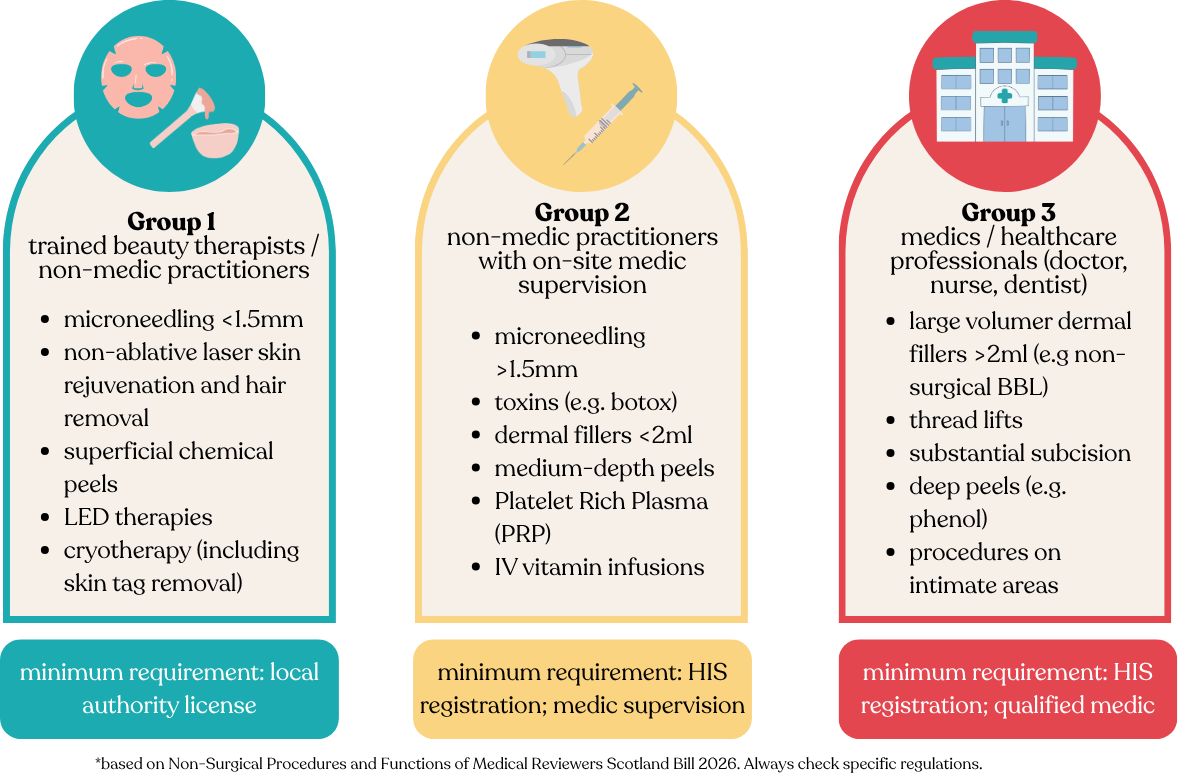
*based on Non-Surgical Procedures and Functions of Medical Reviewers Scotland Bill 2026. Always check specific regulations.
The following treatments, while listed as Group 1, may be escalated to Group 1, depending on your existing equipment:
we can help you every step of the way.